

Note: This piece was written during the first phase of Regenera in Denmark, where a small group of us chose to live from March-May 2026 and research how to build a regenerative culture together.
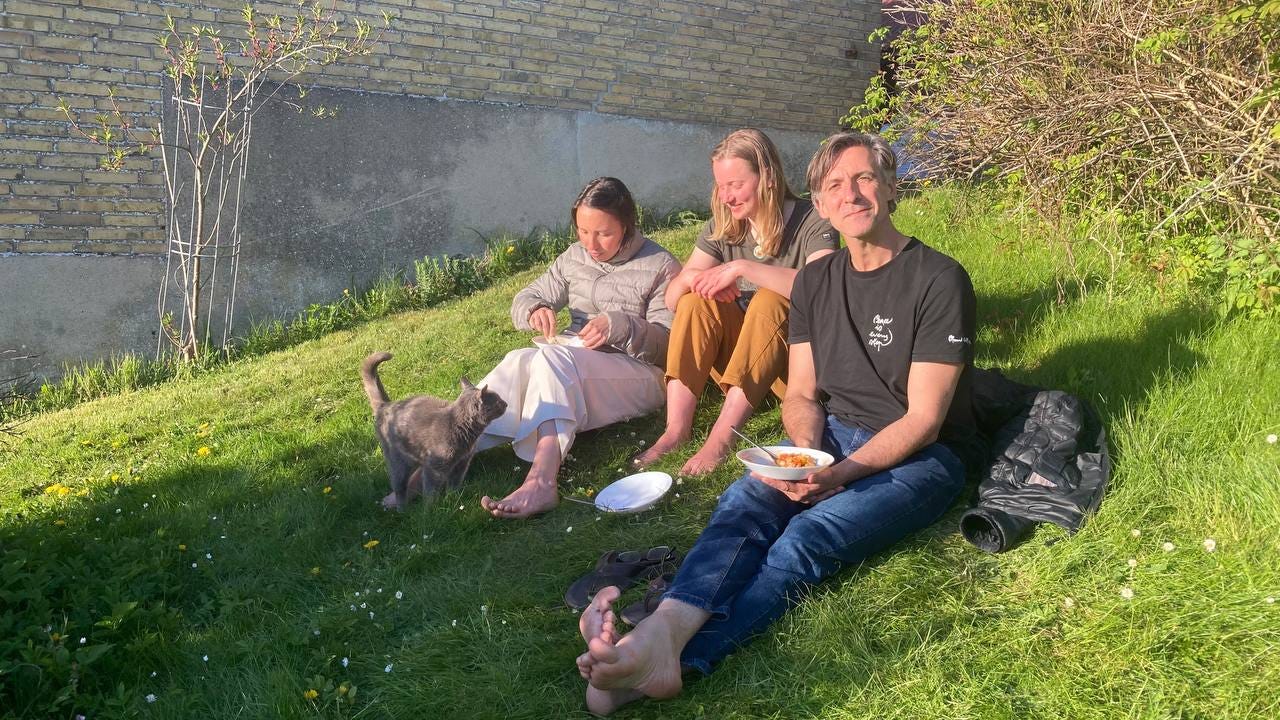
Nearly two months ago, I wrote an article titled “We have arrived.” Since then, a rich and varied tapestry of experiences has unfolded—bike rides into Odense, vocal improv jams, emergent group processes, a peace walk in Copenhagen, diverse forms of emotional healing, a weekend of nourishment called The Well of Being, field trips to the lake, a tango evening on Aon and Vienera’s terrace, and many, many 30-second dance parties.
After some weeks panicking about the impossibility of capturing these experiences in writing, I have decided to accept that my attempts to summarize, describe, and distill will be inevitably partial and incomplete.
This article is a survey of some of the themes that have been surfacing—emotional reactivity, feedback, technology, collaboration, and orienting towards a conscious purpose—with the purpose of giving readers an overview of what building a regenerative culture can look like in community.
Handling Emotional Reactivity
In a community setting, emotional reactivity impacts not only the individual but also the relational field of the group, affecting collective decision-making and what is possible in a space. Since arriving, our group has been intentionally creating a culture where emotional reactivity is met without shame and treated as an opportunity for healing and growth.
Our group has been exploring how to integrate the practices of various modalities—Possibility Management, Internal Family Systems, somatic approaches—in navigating emotions. Different options we have experimented with include:
Creating a held space within the group setting, with the rest of the team witnessing
Creating a separate space outside of the group in order to handle the emotion one on one
“Parking” the emotion, to be handled later (assuming the person who is in reactivity is able to set it aside)
Creating a space for feeling as a group (e.g., three minutes of anger to get clarity on what each person wants or does not want to be happening)
While a longer article on this topic is due, the wider frame for me is the question of how to continue loving myself and others through reactivity—both theirs and mine.
Lone Wolfing Creation
After I published my last article, “We Have Arrived,” Jonas pointed out that I had “lone wolfed” the process by locking myself alone in a room for five hours and not talking to anyone. At the same time, I have been making myself a martyr when it comes to documenting what is happening at Regenera on Substack, Instagram, Spotify Podcasts, and Telegram—telling victim stories like “Nobody cares about this as much as I do” and “I have to do it all myself.”

This is not how I want to live my life—and yet it is often how I have oriented to creation. In middle school, I completed every group project alone because I did not know how to delegate tasks or empower other people’s creativity.
Before writing this article, I shared with Nina and Theo that I felt scared of lone wolfing creation and removing myself from the group in order to write. Nina gave me the possibility of sitting down for a conversation with her to sketch out the framework of the article. This not only supported me in drafting the bones of the piece, but also opened up a discovery space to celebrate what we’ve learned over the past two months.
As I write now, Theo is to my left, creating a mix of a song he and Emma recorded earlier. Jonas is working on the new Regenera website (to be deployed soon)! And I feel glad to be shifting out of my old patterns to discover what else is possible.
Finding A New Map of Work
In many of the community settings I have experienced, “work” is disconnected from daily life and togetherness. People sit on laptops taking calls all day, and what happens in “community” is distinct from how people support themselves financially. During Phase I, many people (including myself) have juggled group time with outside calls and clients. I feel sad about the irony of creating in isolation while being literally, physically in community.
In the vision I hold for regenerative communities, “work” would be fully integrated with community life. This is the aim of places like Tamera, Damanhur, and Findhorn, where people’s jobs (teaching, building, office work, etc.) are intended to both serve the community and generate an income.
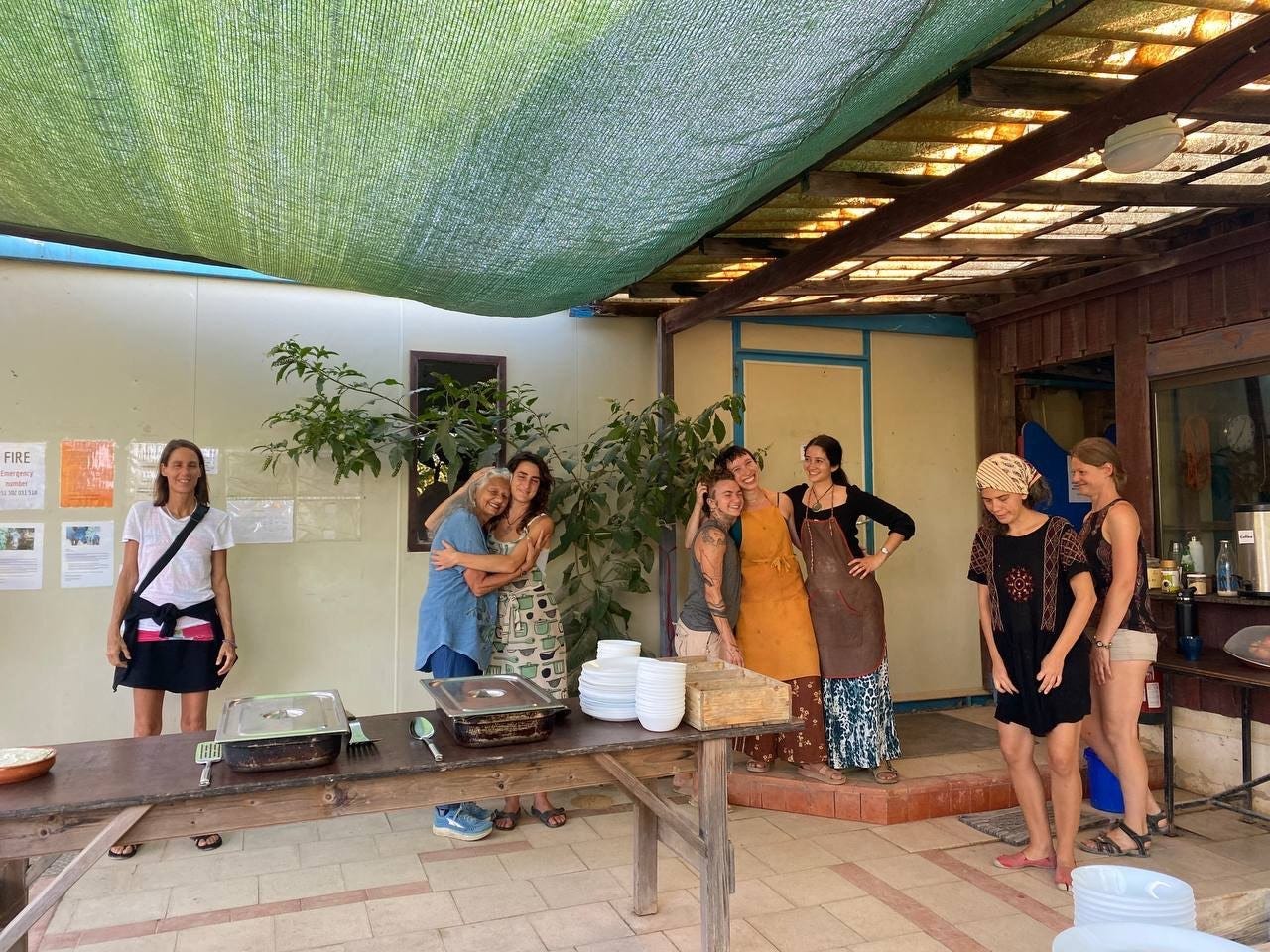
At the moment, many of the people who gather in conscious community are healers by profession, because these ways of relating are not yet normalized in mainstream society. In the future, what I imagine is a village where everyone is a healer, and consciousness is integrated in whatever we do—from gardening and cooking to taking care of children and creating art.
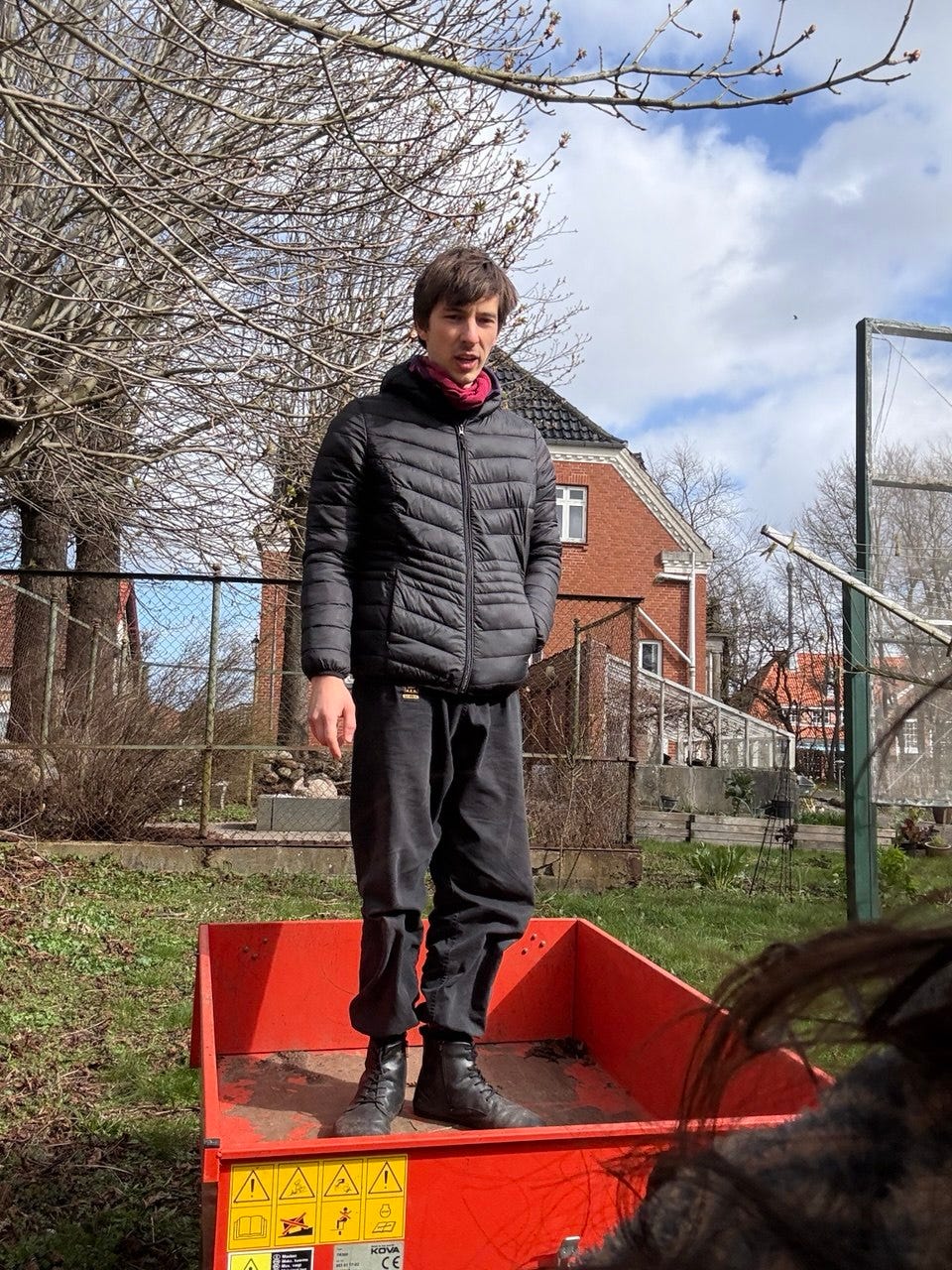
In a temporary setting like our residency programs, earning money within the community is not viable due to structural constraints (timeline, number of people). At the same time, we can create this kind of togetherness by taking care of as many things as possible as a community, rather than outsourcing them—cooking, for example, or cleaning the house (we have a house clean once a week, on Tuesday mornings). One of my favorite activities during our time here at Avalonhuset has been “Buildings & Grounds”—two hours per week where we do yard work and take care of the grounds, including weeding, mowing, and chainsawing dead trees.
Most importantly, however, what is being created here is a culture where consciousness is simply a part of ordinary life. Whether we are doing the dishes or handling logistics, awareness is brought to the ways we are relating and how we can empower each other to be connected to our aliveness, authenticity, and wholeness.
In the meantime, until it is possible to build the physical infrastructure of a self-sustaining village, I am researching how to create a regenerative relationship with digital technology—one that is in service of life. Many of us have been experimenting with making computer use more communal: setting boundaries about time, taking scheduled breaks, working in shared spaces, and writing together instead of separately.
I am also consciously working to move more projects into collaboration: Nina and I are holding space for an online Women’s Co-Creation Circle, and Jonas and I will hold space for the Golden Circle and the Danish Ecovillage Association later this month. It has been incredibly nourishing to create alongside the humans I am currently living and relating with.
Orienting Towards Purpose
One distinction from Possibility Management is: if I do not have a conscious purpose, then I have an unconscious purpose.
At the beginning of April, Emma and Nina held a Purpose Distillation for the Regenera team to get clear on each person’s individual purpose in being here, as well as our purpose as a collective. Our “purpose pieces” are now hanging on the wall and can be viewed in Emma’s article, Connecting To Purpose Inside A Living Experiment.
As a result of this process, we began building more intentional “checkpoints” around purpose. We begin group time with a ‘What do I want?’ practice, inviting each person to consciously choose how they use their time, and end by harvesting what we learned about regenerative culture and how our actions aligned with our individual and collective purpose.
As Nina pointed out, the goal here is not to force every moment into productivity or usefulness. In college, I once did the experiment of tracking every minute of my day down to five-minute increments: checking email, buying a snack, studying, walking to class, etc. While the impulse came from wanting to live intentionally, the method was rooted in control.
The format of checkpoints, on the other hand, has created a level of consciousness that is actually regenerative—giving space for impulses to unfurl, while still remaining connected to a deeper orientation.
What Do We Want To Create Together?
One discovery I keep returning to is that intimacy arises organically when people are creating something together: holding space, writing, cooking, making music. As Emma has pointed out, one of the shadows of conscious community is that people rely on emotional processing to create connection—when closeness is actually the inevitable result of creating, working, and playing together.
I like to use the example of a community coming together to try to bake the best possible loaf of bread. In some ways, it does not matter what the mission is; as long as everyone shares in it, intimacy emerges naturally through meaningful collaboration.
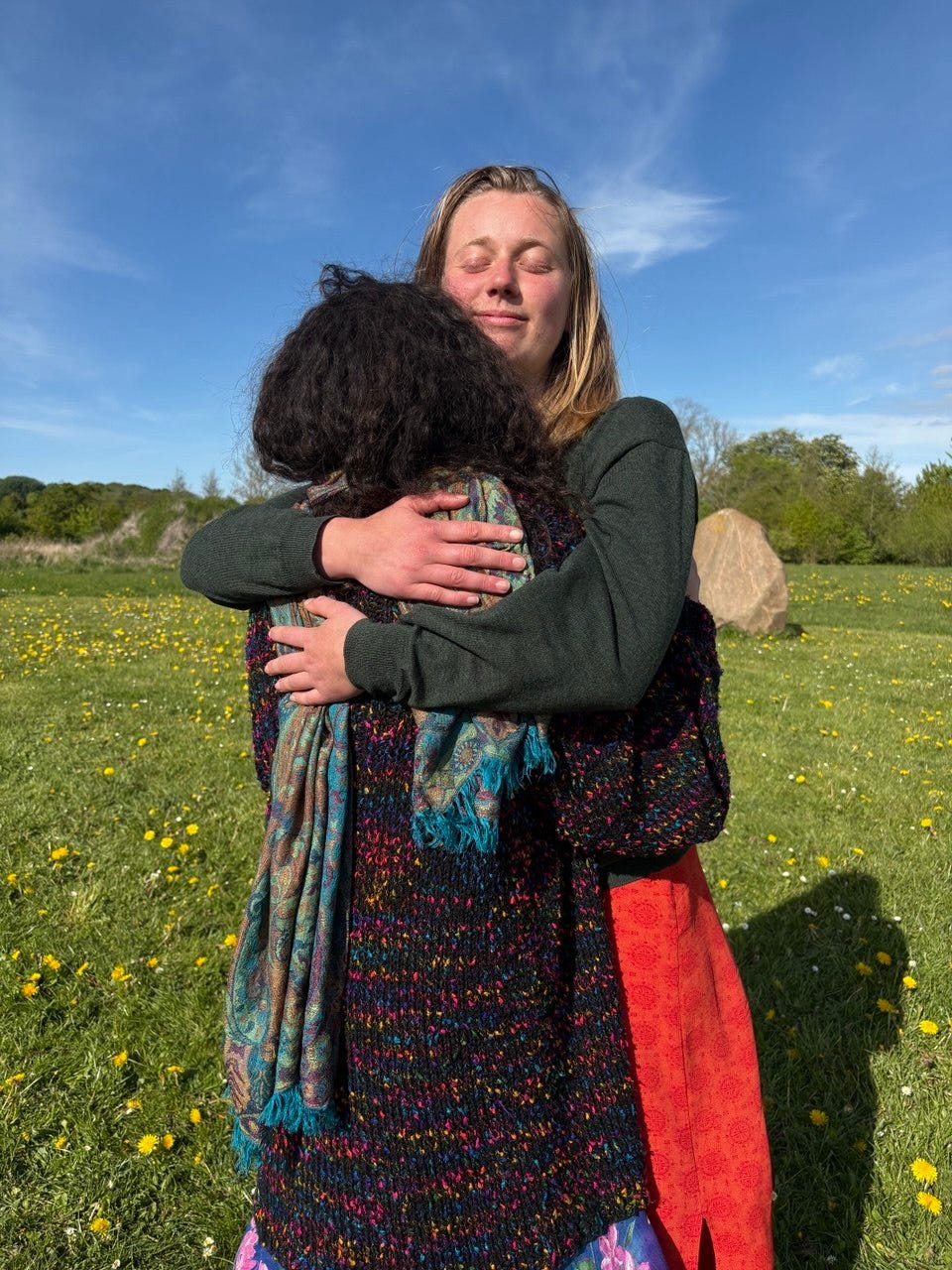
In every moment, I can be conscious of my purpose: To create a beautiful meal. To watch the sunset. To write emails. To share a heart to heart connection. If I orient towards purpose, I can have closeness with anyone by discovering what it is we are meant to create together, no matter how big or small—a business, a cup of tea, a song, a space to feel, a dance, or a hug.
Feedback As Love
During the April intensive days, we worked with the New Map of Feedback & Coaching from Possibility Management. This map supports people in shifting their experience of feedback from a form of criticism to one of empowerment.
The Old Map (what most people learned in school or from their families): Feedback is a correction or evaluation of a person’s worth.
The New Map (an invitation to shift into higher agency and responsibility): Feedback is neutral information about what worked or didn’t work.
I had seen this map many times before. And yet the way I experienced it during the intensive days, in a practice beautifully held by Nina, was entirely different.
In this space, Nina invited the person receiving feedback to slow down and ask themselves: “Can I experience this as love?” At the same time, she invited the person giving feedback to slow down and ask themselves: “Is this coming from love right now?”
For the first time, I understood that the new map—this invitation to shift the way I relate to feedback—is not just for when I am receiving feedback, but also for when I am giving it.
If I am not coming from an orientation of love, with the purpose of being on the other person’s team, then my feedback is contaminated with the purpose of controlling them, changing them, or being right. If I have any kind of attachment to the other person taking my feedback, then I am likely trying to impose my own judgments or preferences. In that case, my feedback is not just feedback—it may be a request for how that person interacts with me, or even a boundary.
As Emma noted, giving and receiving feedback is also a part of building a culture of radical responsibility. If I do not bring my feedback to somebody, it will become a withhold and likely manifest as unconscious tension or resentment that eventually comes out sideways. Taking radical responsibility for my relationships and the group field means bringing feedback consciously and directly.
Group Time Architecture
Over the past two months, we have experimented with different cadences of group time, the times we set aside as a group to relate and create together. Right now, we meet five times a week: 10:00-12:00 on Tuesday, Wednesday, and Friday, 13:30-15:30 on Thursday, and 10:00-13:00 on Saturday.
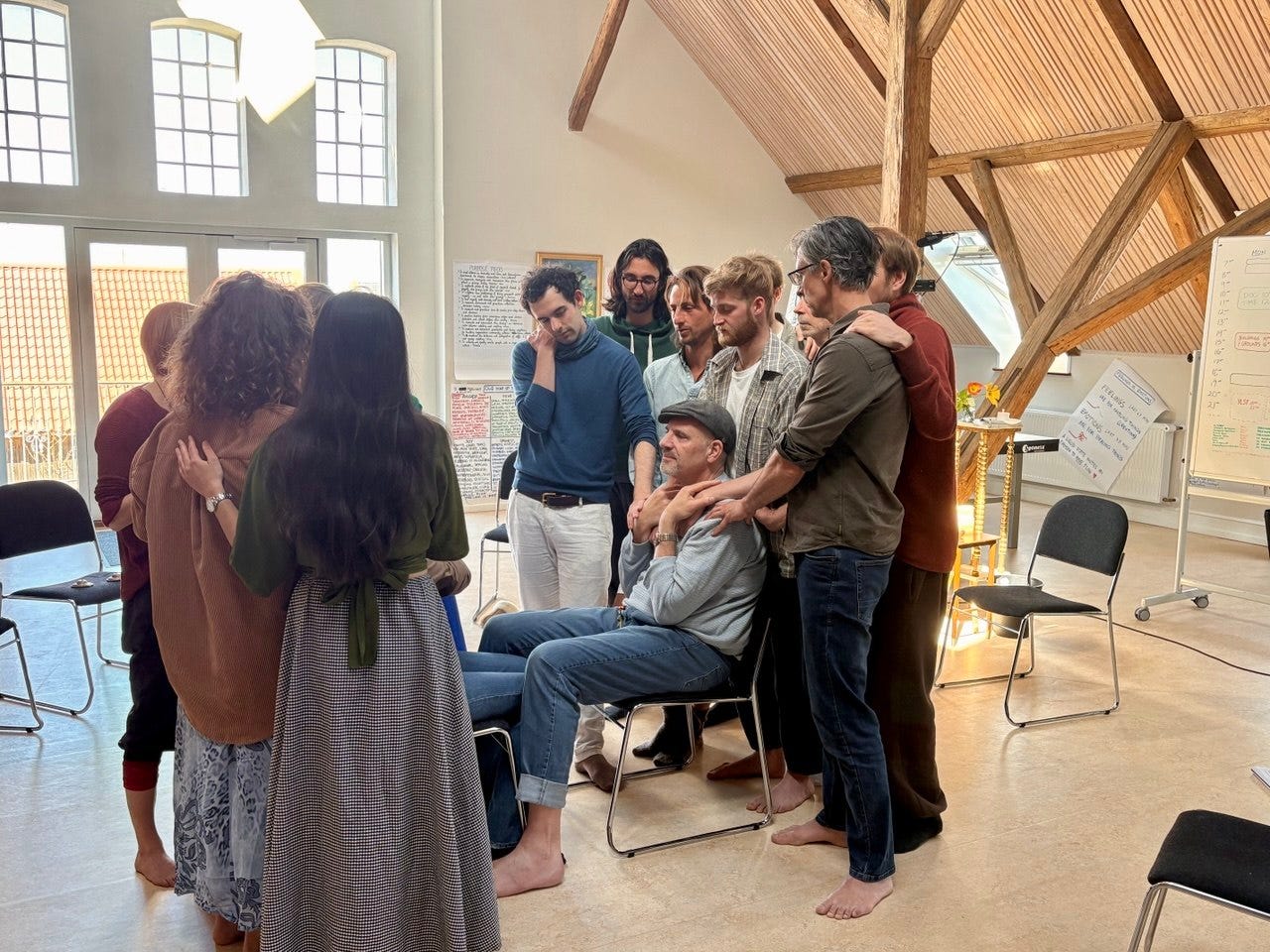
We have developed the following as a “group time architecture” to loosely follow, while still allowing space for emergence. I share it here as a template others may find useful in holding spaces where each person is empowered to bring their impulses and voice.
Centering: 5-10 min to center and land together in the space.
Logistics: 20-30 min to take care of any practical matters (schedules, requests, offers, proposals).
Feelings: 5-10 min of feeling as a group to move the energy in the space.
“What do you want?”: Everyone takes 2 minutes of silence to sense into what they want to do during group time. After people have shared their impulses, one person (the spaceholder) weaves them into a coherent proposal or lets the group self-organize.
Harvest: 5-15 minutes reserved at the end of group time to harvest what we learned about regenerative culture, community building, and how what we did aligns with our purpose.
Another practice we experimented with was a “temperature check” before the logistics space. The spaceholder might ask: “How much energy do you have?” or “How much patience do you have right now?” People use their hands to indicate an answer, with above the head meaning “a lot” (e.g., high energy, very patient) and at hip level meaning “not at all” (e.g., low energy, impatient).
This simple practice creates a culture where people are encouraged to notice and communicate their internal state, rather than unconsciously acting it out on the group. Radical responsibility, in this situation, means bringing awareness to how I am affecting the space around me. And when I see that other people are aware of how they are showing up, I am more able to meet them where they are—low energy, overwhelmed, impatient, reactive—with grace.
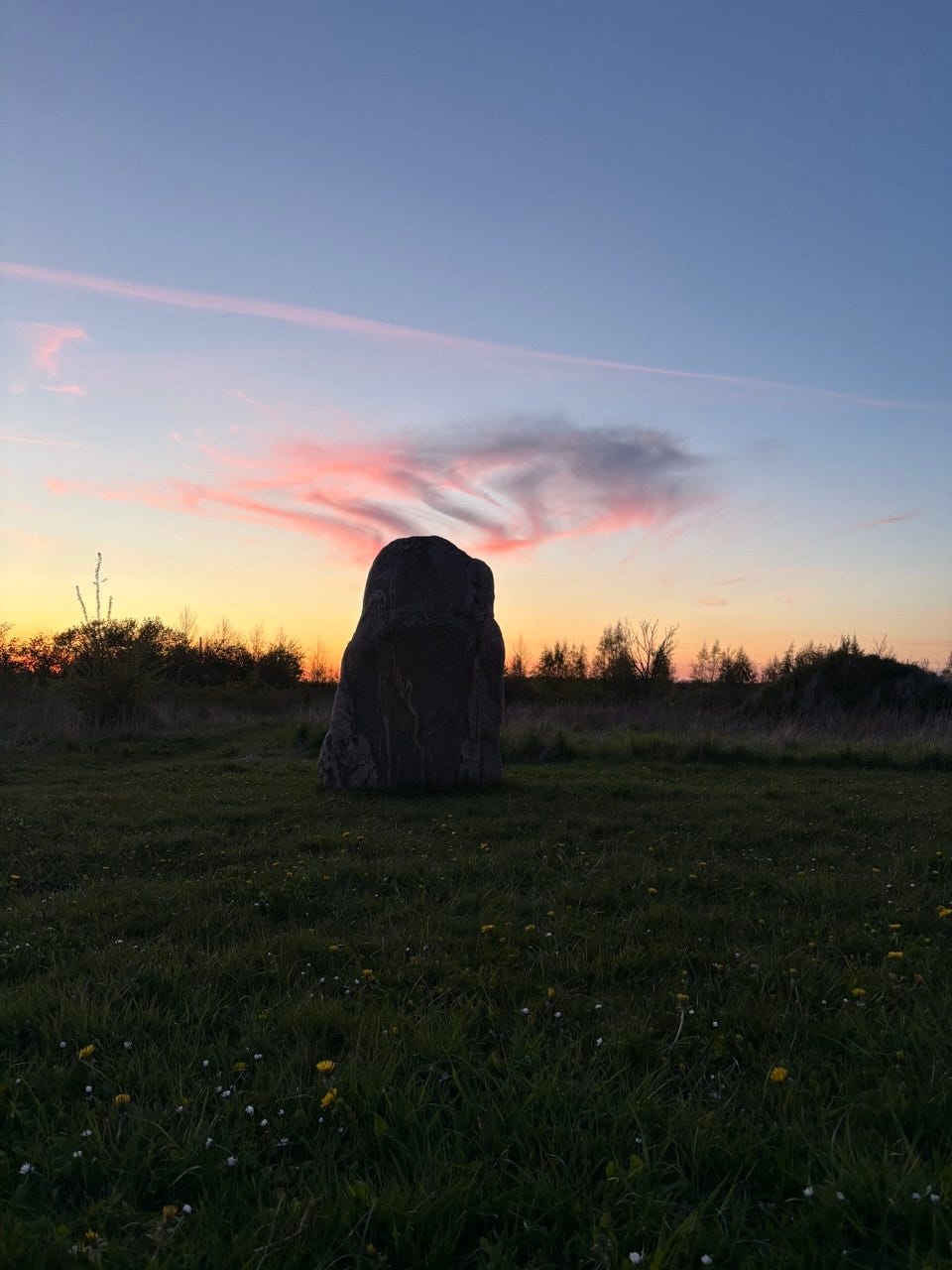
These past months have been nonlinear, alive, and deeply healing. Now, with only two weeks left, I find myself prematurely nostalgic for what we have created here.
Usually, my intention is to be fully present, without projecting into the future or lingering in the past—and yet there is an added sweetness that comes from recognizing the fleetingness of these moments together: Theo dancing in the stone circle. Matias playing his drum on the lawn. Ursula and Emma on guitar. Gaspar’s flute floating down the stairs.
I am grateful for everything I have experienced during this time—for the learning and growth that is possible in community, and for the depth of the human heart.
Hannah Hirsh
May 2026
Åsum, Denmark