
What Holds Us
Containment as a Community Practice

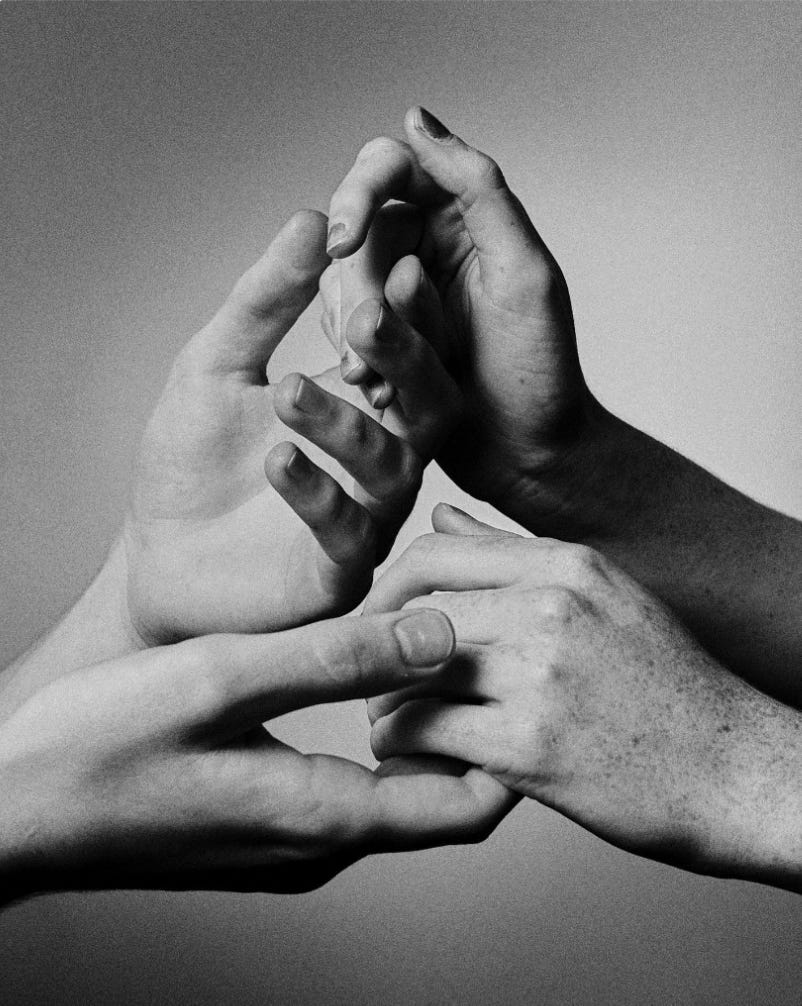
One of our community members came behind me while I was sitting, wrapped his arms around my chest, and stayed. No agenda, nothing needed from me. Just presence, weight, and breath.
My whole body relaxed. The woman sitting across from me laughed, and joked about how envious she was, watching my system unwind so completely.
This moment crystallized something I have been longing to bring forward, in, for, and about community - that there is a kind of nourishment my nervous system needs that individual healing work and individual rest does not fully provide. Something that can only come through another body, another presence, another regulated nervous system: the deliberate act of being held.
And beyond my own personal need for that, I believe that communities also flourish in response to this specific type of care - the practice of containment.
Embodying the Container
Containment is a set of practices and tools for creating and holding the space inside of which I, or someone else, can release, regulate, and resource. As I practice it, containment does not seek to restrict anyone, or make anything (uncomfortable feelings, intense experiences) go away. Containment is the experience of building the frame inside which my nervous system can find its way home.
In order to embody containment, I call forth distinct qualities in myself that I continue to increase my capacity to hold - presence, patience, clarity, and groundedness. My embodiment of these is exactly the same skillset I use to offer containment to others. When I am contained within myself, when I am grounded, regulated, and centered, I find that my presence simply becomes the container for someone else. If I can say, “I’m here,” with as much honesty and clarity through both my words and my body, then I can offer containment.
The Foundation: Self-Containment
I taught a workshop called “Containment 101” at Regenera last week. We started at the foundation - how to contain oneself. My desire in offering self-containment practices was two-fold:
To introduce containment as a practice. Being present, patient, clear, and grounded are not static traits that I have or don’t have, they are practices. The self-containment tools we went through are practices through which each of us can cultivate these states within ourselves.
To land in the field that offering containment to someone else is the same thing as creating self-containment.
We explored a number of self-containment practices, including the following:
Box breathing - a breath pattern that involves inhaling, holding the breath at full, exhaling, and holding out at empty, on a consistent count. Also known as a square breath (so, literally a container!), I find that this breath pattern can regulate my nervous system within minutes, and is simple enough to do pretty much anywhere.
Acupressure - I shared the four points that I find particularly supportive for self-regulation. I offered these because I find them to be really effective, yet subtle low effort, interventions for when I feel ungrounded or outside of myself:
KD1: a grounding point on the bottom of the foot that anchors the kidney meridian, and is often used to ground and ease anxiety.
DU20: a point on the top of the head that lifts energy and clears the mind;
CV17: a point at the center of the chest, also used for regulating energy flow and calming anxiety; and
LI-4: a point on the hand between the thumb and index finger that relieves head and facial pressure.
Self-touch - hand on chest, arms wrapped around, hands tucked under armpits. Nothing revolutionary, but a space to explore the actual quality of the touch that we use on ourselves. How can I be intentional, patient, and loving in the way that I experience my own body, and the relationship between my hand laid on top of my skin?
Holding Me, Holding You
Once we were properly self-contained, we shifted into offering containment to each other. We moved through three layers - presence, breath, and touch.
Practice I: Attention Out/Attention In
Adapted from Kasia Urbaniak’s work, one person places their full attention outward on the other. The other person puts their full attention inward on their own experience.
We oriented towards this with a practice mindset: what if there was simply no other option in the moment? What if there was nothing you could do in this moment besides place the full beam of your attention on this other being?
What if everything that was happening around you became fully folded into your internal experience? How would you need to have your body, who would you need to be in this moment to have your attention in this direction?
The person with attention out (the “container”) offers simple descriptive “you” statements: “You just smiled.” “Your inhale shifted the position of our chest.” “Your eyes are green”. “You have a forehead.”
The last statement produces a wave of surprised laughter across the room. As soon as the pure ridiculousness of telling someone they have a forehead settled, something more tender landed into the space. Under every simple observation was the same profound message: “I am here with all of you.”
Practice II: Breathing Another
Seated across from each other in pairs, making eye contact, the container guided the inhale, and the containee released into the exhale. Minutes passed as the pairs breathed together, the container growing taller as they held the frame of the inhale, the containee sighing deeper and deeper into the exhale. We expanded upon the skill of the first exercise - learning how to track each other, and open to each other deeper states of presence and surrender.
Practice III: Physical Containment
The last layer was touch. I demonstrated with one of our community members, moving from the simple, low-contact experience of holding his hand, and escalating through different holds:
Hands on shoulders pressing downward;
Hands on the chest and back;
Hands on hips grounding down;
Hands on the occiput and sacrum;
A full hold chest to back
Each hold offered the same qualities: weight, warmth, and even pressure, fully supported by the container’s presence and attunement.
Each partner had five minutes to offer physical containment to the other. Two minutes in, the sound of one participant’s sobs filled the room. She shared afterwards the sense of immediate relief and release she had experienced as her partner held her, allowing whatever she was holding inside to unfold.
After closing the workshop together, the group gravitated almost immediately back into holding - every member of the community united in the act of embrace. It could not have been more beautiful in that moment.
But why does something like this matter long term in the community?
Holding the Holders of Healing
At Regenera, we do a tremendous amount of informal and formal healing and integration work together, so that we can create more options than our default protective patterns and survival strategies. We are committed to peeling back layers of reactivity and wounding so that we can unfold into our wholeness, both on an individual and a collective level. This work is essential and ongoing for us, and we hold and are held in healing spaces by each other on a near-daily basis.
And I notice that, particularly when I am engaged in more intensive healing work, my nervous system can get blown out in such a way that impacts how I can show up to our group. I have uncovered that the missing piece for me is not more rest or processing - it is regulation in connection.
This is where the concept of containment, which is consistently practiced in kink, BDSM, neo-tantra, and conscious relating communities, began to feel newly relevant. In those lineages, containment serves as the bookend practice (and is often called upon many times in between) for intensity and edge work. Stripped of any erotic or taboo implications, something more simple emerges about the relationship between containment and intensity. The quality of the container determines what can safely happen inside of it. Any type of intensity, profound expression, or impact - whether it be physical, emotional, or transformational - requires a container that is strong enough to hold it.
In community life, we are constantly entering each other’s worlds. We share space, meals, stories, feelings, challenges, and longings. The question isn’t whether we will impact each other, because there is no way that we won’t. My question then becomes - how can I build and sustain my inner and a collective structure to hold what arises?
The Group Body
I have discovered that the communities I have lived in, even for short amounts of time, develop something akin to a shared nervous system. Beyond just being aware of how I impact and am impacted by others by existing in close quarters, there is a moment where I suddenly realize that I am a limb in some organism that extends beyond my own skin. I call this the group body.
At its healthiest, the group body is a state of regenerative interdependence: each person choosing to take responsibility for the group field, while remaining in contact and connection with our individual parts.
Like my human body, the group bodies I have been part of are unreasonably resilient and surprisingly fragile.
When the group body frays, I have witnessed everyone involved shifting, to some degree, into survival. In our group sessions at Regenera, I have experienced this happen sometimes in the blink of an eye. When someone in the group becomes dysregulated, within moments, triggers ripple through the room. Some people snap, others freeze.
This is one of many situations where I see containment as a profound resource and impactful toolkit for re-establishing group body coherence.
Self-containing in those moments of group body instability does not mean suppressing what is happening or magically erasing the triggers. It means grounding into what is really happening in the moment, and orienting towards revealing, supporting, and integrating. One regulated person in a room can shift the entire field.
The Dance of Holding
In a therapeutic relationship, the holding goes one direction. The roles are explicitly boundaried, and this clarity can support establishing safety on both sides. Living in community, something else becomes necessary.
To offer healing or containment to each other, we are required to navigate sometimes rapidly, and always with care and attunement, between the polarity of holding and being held, and reciprocal relationship. As we build these skills of offering each other containment, we also expand each of our capacities to set boundaries - to be clear about when we are offering containment, when we are requesting that containment from someone else, and when we are operating from mutuality.
What I have experienced at Regenera is that our collective ability to set and communicate clear boundaries - both in service of containment, and around the practice of containment - expands our ability as a community to maintain the level of regulation necessary to move forward at the speed of transformation. Containment as a community practice guides our group body into states of higher and higher resilience and attunement.
Containment 101
If this inspires you to bring even just a seed of this to your communities or relationships, I invite you to start with self-containment.
Presence. Patience. Clarity. Groundedness.
The more you can hold these within yourself for yourself, for every part that exists inside you, the more time you are able to look into someone else’s eyes and say, I’m here.
The goal of containment is not to be unaffected - not to transcend triggers, or rise above conflict inside or outside of yourself. What I have received from containment (among many other practices and modalities!) is a resilient and regenerative inner structure - a place inside myself that I can return to over and over again so that I can be available and present in reality for what is meant to move through me as an individual and collective.
If you have a desire to introduce these practices into your life or community, please reach out - I want nothing more than to share the profound and moving impact of this aspect of community care.
Dear Nina,
I resonate with what you've written here, though I haven't thought of it as containment. But it reminds of the movie about the brilliant autistic woman who designed a device that pressed her body all around, that she could use when she was overstimulated. It provided containment just as you spoke of it in the first paragraph.
At Inla Kesh community in Mexico, Monika introduced a practice in pairs of walking towards one other maintaining eye contact. Each takes hold of the other, right hand to left shoulder, and silently expresses acknowledgement and presence. Powerful, purposeful, poetic connection.
Thank you for your research and writing, Niina. I want this in my life and I love knowing how you've brought it into yours. (and the Regenera village).
Love,
Leslie