
Freedom Means Choice
On finding ease in our quest for belonging and truth

Readers unfamiliar with the frameworks of Internal Family Systems, Nonviolent Communication, and Possibility Management that underlie this piece may find a fuller introduction in Overlapping Maps.
“I keep sitting here wanting to bring my voice to the group, but I’m too scared to do it — and I get so angry at myself.”
We’re at grouptime during Phase I of Regenera, all sitting in a circle. We’ve heard variations of this before. Some of us nod slowly, in empathic understanding — we know this conflict within ourselves. Others share their joy, celebrating that the person is finally daring to name what’s been happening inside them. A couple of people are looking at the floor, their eyes distant.
Two needs
We come into the world in a state of extraordinary vulnerability — more so than almost any other species, and for much longer. The human infant cannot regulate its own nervous system, cannot meet its own physiological needs, cannot survive alone. What it can do, with astonishing precision, is orient toward the caregiver. The need for attachment is not one feature among many in early development — it is the organising principle. Prolonged dysregulation in the absence of an attuned other is not metaphorically dangerous at that age. It is existential. The body learns this long before language arrives, and does not easily forget.
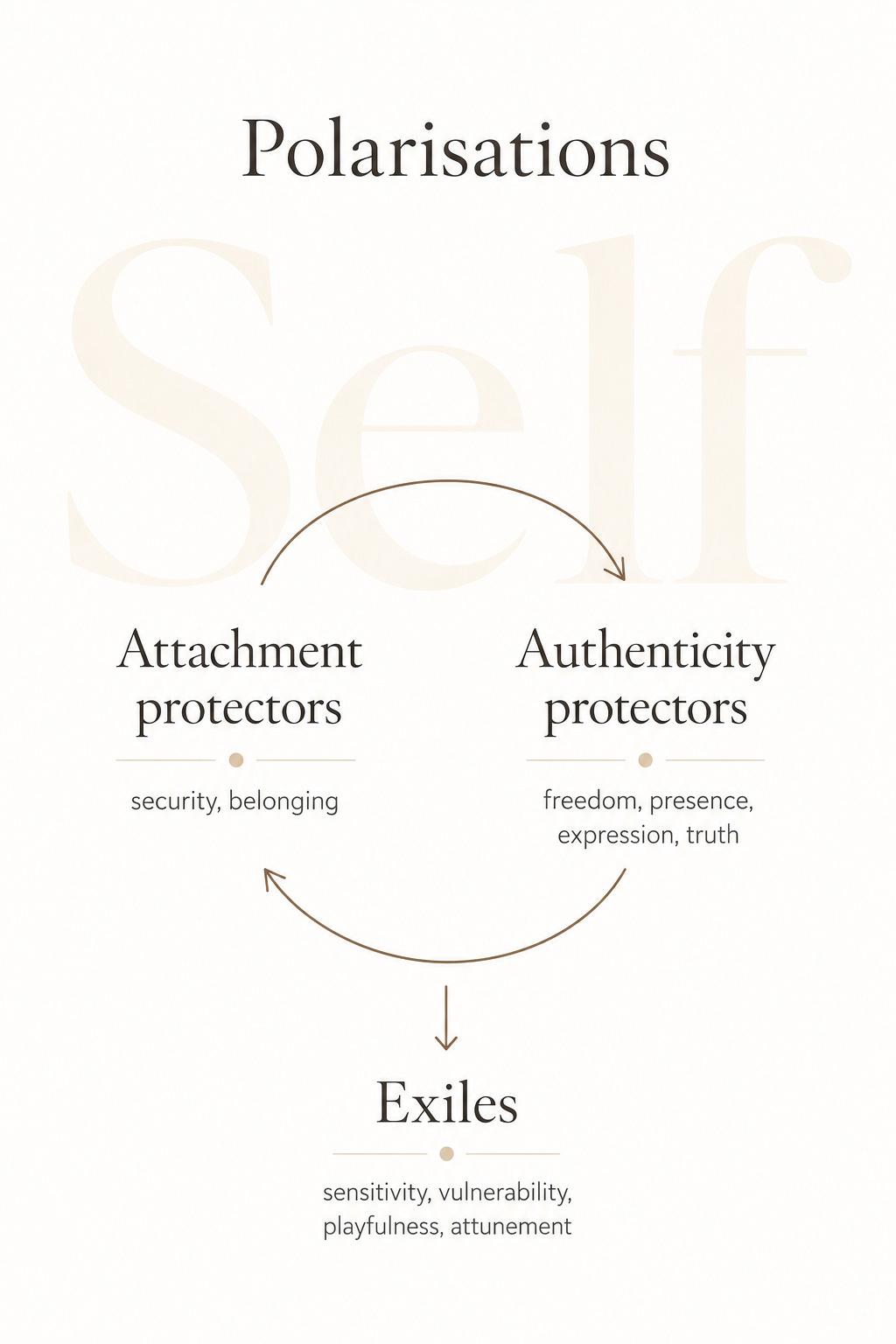
Alongside attachment, the child carries another need of equal depth: authenticity. If attachment means security and belonging, authenticity means freedom, presence, expression, truth. Neither need is a luxury. Neither is a personality preference. And they are not intrinsically in conflict. The split between them occurs through what particular gameworlds can and cannot accommodate.
The split
When the caregiver is not fully present — operating from their own unresolved wounds, their own accumulated protections — attunement falters. Not as personal pathology, but as the structural transmission of a gameworld with its own implicit rules about which parts of experience can be welcomed and which cannot. The child’s system reads this relational field with extraordinary sensitivity, learns which expressions maintain the bond and which place it at risk. And then it does what any system under existential pressure will do: it protects what it cannot afford to lose.
What gets pushed underground tends to be precisely what was most alive — the sensitivity that was too much, the vulnerability that the adults couldn’t hold, the anger that had no place, the grief that went unwitnessed, the playfulness that no one had time to nourish. The child’s parts — those already-present inner voices, feelings, and impulses that compose the internal system — take on protective roles around what has been buried: some working to keep the surface carefully managed and the bond intact, others reacting when the buried feeling gets activated anyway, numbing or erupting or pulling the whole system away from the edge.
Over time, two poles of protection consolidate around the original split. On one side: parts organised around attachment, monitoring the relational field for signs of threat, keeping expression carefully controlled, maintaining belonging at the cost of full presence. On the other: parts organised around authenticity, carrying the long-suppressed bid for expression, the frustrated impulse toward truth, the accumulated charge of what was never allowed to surface.
The attachment protectors’ expression is not securely attached expression — it comes from fear, it carries an agenda, oriented toward maintaining a bond that still feels, somewhere in the system, as though it could be lost at any moment. The authenticity protectors’ expression is not authentic expression — it carries the charge of long suppression rather than the clarity of genuine presence, and it too has an agenda: to finally be heard, to finally be allowed. Neither pole is the wound. Neither is the truthful expression of the need it is protecting. Both are young parts, doing what young parts do — defending, with the full intensity of the original danger, something that once felt like everything.
A reinforcing loop
A polarisation is not a stable state. It is a reinforcing feedback loop: each side’s movement activates the other’s response, which confirms the first side’s fear, which intensifies its strategy, which provokes a stronger response — and so on, until the system is flooded with the overwhelming feeling that was buried underneath all along. Other parts come in to prevent this: some by avoiding the situations that might trigger the polarity altogether; others by pulling the system out when it gets too close — through food, distraction, numbness, anything that interrupts the escalation before it becomes unbearable. These are not failures of will. They are the system doing exactly what it learned to do.
And the polarity does not stay inside. A part organised around a wound carries that wound’s logic into every room it enters. When we come in blended with either side — speaking from or just being present and blended with the attachment protectors’ fear or the authenticity protectors’ charge — we activate resonant polarities in the people around us. They will side with one part or against it, and the relational field will organise itself around the same split that was originally internal. What begins as one person’s wound becomes a group dynamic. Scaled further, this becomes the structure of a conflict — each side convinced it is standing for something true. We see this everywhere: in couples, in communities, in the wars around the world.
Welcoming polarised parts
Having a polarisation active does not mean one is helpless, or necessarily pulled to one side or the other. Most of us know the feeling from the inside: something gets triggered, and suddenly there is a familiar weight — the pull to go quiet, or the pull to push through — and it is very difficult to remember that there is any other option. The part has the steering wheel, and it drives with the certainty of someone who has been here before, many times, and knows exactly what is at stake.
However, if there is enough Self-energy present — enough capacity to step back from both parts without abandoning either of them — something else becomes possible. Not immediate resolution. Not the disappearance of the conflict. It is possible to be with both sides, bringing compassion to the attachment protector’s fear and presence to the authenticity protector’s frustration, without siding with either, without needing the tension to collapse before one can act. From that more spacious place, it becomes possible to speak for both parts — to find creative strategies that honour both needs at once, even imperfectly, even provisionally. This does not require the underlying wound to have been healed. It requires only enough presence to hold the whole picture, and enough trust that the picture can be held.
The risk in new gameworlds
Mainstream culture tends to celebrate the attachment side of the polarity: compliance, accommodation, the careful management of expression to maintain belonging. Most of us arrive in spaces like Regenera with years of that behind us. When a gameworld finally offers the authenticity protectors space — when the implicit rules shift, when expression is not only permitted but welcomed — something releases. The relief is real. The charge that surfaces is real. It can feel, from the inside, unmistakably like coming home.
Any gameworld, however conscious in its intentions, will tend to valorise one side of the polarity over the other. A community like Regenera, organised around authentic expression, clean feeling, and conscious presence offers something essential: a place where parts that were completely suppressed can finally breathe, where the people-pleasing and caretaking protectors can begin to relax, where previously invisible patterns come into the light. This has immense value. For many people, an environment like this can be the beginning of something that might genuinely change their lives.
At the same time, there is a subtle risk we need to watch out for: that the authenticity protectors get celebrated as the real thing — as genuine Self-expression, as clean feeling — without the awareness that they are still protectors, still organised around a fear, still carrying the charge of what was suppressed rather than the clarity of what has been healed. The burdened emotion gets mistaken for clean feeling. The part gets mistaken for Self. And the message that lands, however unintended, can be: your attachment protectors are the problem. The person who has spent years carefully managing their expression to maintain belonging — who has, in other words, been doing the only thing their system knew how to do — may find themselves sitting in a circle, hearing that the very strategies that kept them safe are now the obstacle. That the careful, frightened part of them that learned to go quiet is what stands between them and their own life. It is a heavy thing to be told, even gently. Even with the best intentions.
The authentic expression of both attachment and authenticity is Self-led. It carries much less agenda. It has genuine creativity and range in the strategies it can choose — and it is far less likely to generate reactivity in others. From that place, we can make real requests rather than demands: requests that are spacious, that allow for a no, for a counter-proposal, for creativity within the relationship — because they are not strategies over-identified with a need, but genuine invitations from a system that trusts, at least a little, that the need can be met more than one way.
The wound underneath
Underneath both protectors — underneath the polarity itself — there are exiled parts carrying the original wound: the feeling that never completed its arc, the need that went chronically or acutely unmet, the implicit memory that still reads the present through the logic of a much earlier danger. These parts carry the qualities that were pushed underground: the sensitivity, the vulnerability, the playfulness, the capacity for deep attunement. They are not damaged versions of the person. They are among the most precious things the person carries.
Reaching them requires care about pace — particularly with the attachment protectors, who may need to move very slowly, and for good reason. They are protecting wounds that are, in many cases, among the deepest the system knows. Trying to push past them toward the exile — treating their caution as information to be overridden rather than as a path to be followed — is a little like encountering great boulders on a mountain trail and reaching for the dynamite. The path exists. It winds between the rocks, through the shade, along the water. It asks to be found, not forced.
What heals at that depth is the person’s own Self meeting their own part — possibly with the presence of another Self in assistance. That contact, internal and relational at once, is what allows the implicit memory to update, the arc of feeling to finally complete, the burden to be laid down. When it happens, what is released is not only the exile’s qualities returning to the system, but the energy that was spent maintaining the internal war — energy that becomes available, now, for courage, for compassion, for genuine presence, for all the qualities of Self that were always there but could not move freely while so much of the system was occupied with the fight.
The protectors, no longer organised around a wound, can begin to turn toward the world differently — not as defenders of an old danger, but as carriers of something that was always meant to be expressed. And being in community can assist us with making that turn.
What community makes possible
There might be moments in a relational field when one person’s wound is active and the other has enough Self-energy to stay present with it — when we can say to the person who is triggered or in internal conflict: I can see something is happening for you. It makes sense that it is. We can go slowly. I’m going to take care of my own limits so I can stay genuinely open to what you’re bringing. You’re not alone in this. That quality of presence — neither fixing nor retreating, neither siding with one part nor against it — is perhaps the most precious thing one person can offer another. It is attachment functioning as it was always meant to: not as a bond maintained through the suppression of truth, but as the ground from which truth can be safely approached.
And there will be other moments — when one person’s wound activates another’s, when two systems find themselves in a polarity that neither can hold alone. In those moments, being able to say I notice this is moving something in me too, and I’m not sure I can be fully present with you right now — and for the other to hear that not as abandonment but as honesty, and to say then let’s find someone who can hold space for both of us — is not a failure of the relationship. It is the relationship functioning well.
It is attachment as resource: the community as the larger nervous system within which individual’s regulation becomes possible, the field that can hold what the dyad cannot.
This is what regenerative communities are, at their best, building toward — not a gameworld where one side of the polarity is celebrated over the other, but a field with enough collective Self-energy that our wounds, at whatever pace they need, can actually be approached and healed.
Finding ease
In such a setting, authenticity doesn’t become an end, but the baseline we can inhabit with courage and ease. A place to which we do not arrive at once, which we do not hold permanently, but which we return to, again and again, as our systems find more room to breathe. And attachment, from that place, can become something else than a source of fear. It is what emerges naturally around a system that is safe within itself: warmth, recognition, and love that do not need to be won, managed, or defended.
This article was written in accompaniment to a workshop co-created with Karl Steyaert during our shared time at Regenera Phase I. Karl’s contributions shaped much of what is written here. I am grateful for his friendship, clarity, honesty, and patience with my own inner polarisations that surfaced during our collaboration.